
Nordification.com | Build | Power
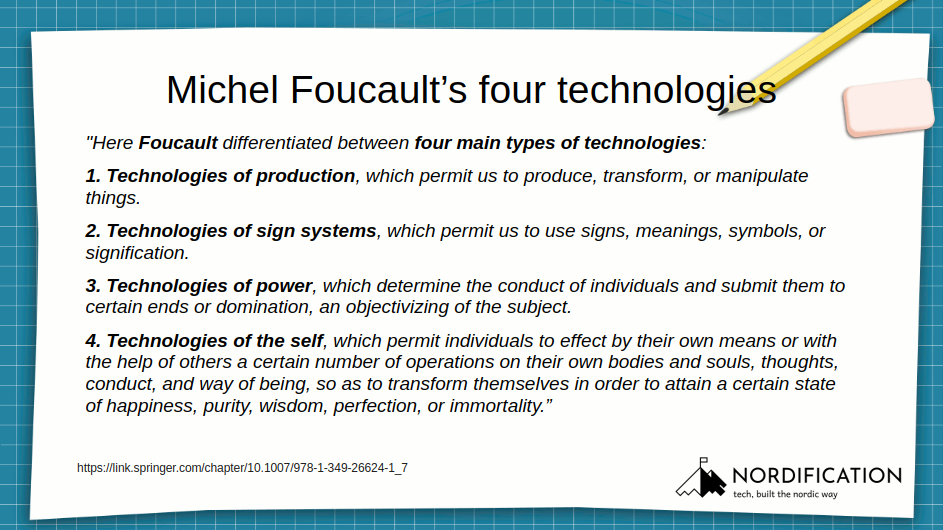
Michel Foucault’s definitions of technologies include four distinct types. These four ways of doing technology inform Nordification.
This page is about the third one:
“3. Technologies of power, which determine the conduct of individuals and submit them to certain ends or domination, an objectivizing of the subject.”
Power
Global organisations wield power like no institutions in history. More than many nation-states. The responsibility should be considered sacred. Instead, it’s every corporation for themselves: and let the buyer beware.
What’s missing from the mix? Surely … respect. Respect is earned, they often say. Perhaps, then, when big tech fails to respect a lot of us, we are part of the problem. If a Silicon Valley corporate body chooses to ride roughshod over all local and regional rules and regulations, and is able to just because it’s more fleet-of-foot, maybe we haven’t aspired to better.
But “just because you can” doesn’t mean you should. Russia can, and is so doing. Is that the approach big tech continues to want to follow? Is that level of respect’s total absence how the Valley would like history to remember its trajectory and legacy?
I would hope not. Part of the reasoning and thinking behind Nordification, too.
I remember a story I was told at a lunchtime event in the mid-2000s in London. The guest was Bill Patry, General Counsel for Google. He used the example of the Melian Dialogue to describe the relationship the rest of the world had to accept was its place in respect of corporations like the one he worked for.
Read more about this ancient dialogue in the information box.
At the time, even then, I was taken aback by how open he felt he could be. But in the event, recent history has proven him largely right.
Here at Nordification, following the example of places like the Nordics where things in tech are already done differently, we can spread ways of seeing — and therefore ways of doing — in firm and resilient ways.
But what’s more, I think recent events in the fields of big tech make it imperative that we do.
Don’t you?
The Melian Dialogue
“The siege of Melos occurred in 416 BC, during the Peloponnesian War between Athens and Sparta, when the Athenians attacked Melos, an island in the Aegean Sea roughly 110 kilometres (68 miles) east of mainland Greece. Though the Melians had ancestral ties to Sparta, they were neutral in the war. Athens invaded Melos in the summer of 416 BC and demanded that the Melians surrender and pay tribute to Athens or face annihilation. The Melians refused, so the Athenians laid siege to their city. Melos surrendered in the winter, and the Athenians executed the men of Melos and enslaved the women and children.
This siege is best remembered for the Melian Dialogue, a dramatization of the negotiations between the Athenians and the Melians before the siege, written by the classical Athenian historian Thucydides. In the negotiations, the Athenians offer no moral justification for their invasion, but instead bluntly tell the Melians that Athens need Melos for its own ends and that the only thing Melians stand to gain in submitting without a fight was self-preservation.[1]
The Melian Dialogue is taught as a classic case study in political realism to illustrate that the world is anarchic, that states are motivated by selfish and pragmatic concerns, and that the only rational approach is based on power and advantage.[1][2] In particular, the quotation ‘the strong do what they can and the weak suffer what they must’ is taken as founding statement of political realism.[2]”
Taken from: https://en.wikipedia.org/wiki/Siege_of_Melos
Relevant links
From some of our sites:
https://www.niokvinnor.com/more/activity | Dividing production into three processes of radically improved functionality: two are prior to the engineering and upscaling processes themselves, but their proposed structures are quite distinct from what’s currently on offer
https://newlean.org/why | Why we need privacy-sensitive, and even secrecy-positive, software discovery environments to improve the accuracy of software and hardware development
https://gb2earth.com/blog/three | The 3Rs of agnostic, and therefore much more relevant, software and hardware consulting